November, 2008

...now browsing by month


Gratitude Visit

Sunday, November 30th, 2008

In 2004, Martin Seligman told a group of us on a conference call that a specific exercise in which a person expresses gratitude was the single most effective intervention in the budding field of positive psychology, according to the limited research available on these new techniques.

At the University of Pennsylvania, Seligman teaches a course on positive psychology, and has his students plan and carry out a “Gratitude Visit” as an assignment. In his best-selling book Authentic Happiness: Using the New Positive Psychology to Realize Your Potential for Lasting FulfillmentAuthentic Happiness: Using the New Positive Psychology to Realize Your Potential for Lasting Fulfillment, Seligman says that in his course evaluations he gets comments like “October 25th was one of the best days of my life.” He recommends all readers to do the exercise, and gives the following instructions:

Select one important person from your past who has made a major positive difference in your life and to whom you have never fully expressed your thanks. (Do not confound this selection with new-found romantic love, or with the possibility of a future gain.) Write a testimonial just long enough to cover one laminated page. Take your time composing this; my students and I found ourselves taking several weeks, composing on buses and as we feel asleep at night. Invite that person to your home, or travel to that person’s home. It is important you do this face to face, not just in writing or on the phone. Do not tell the person the purpose of the visit in advance; a simple “I just want to see you” will suffice. Wine and cheese do not matter [he mentioned in the book that this was part of “Gratitude Night” where students brought guests to a joint event], but bring a laminated version of your testimonial with you as a gift. When all settles down, read your testimonial aloud slowly, with expression, and with eye contact. Then let the other person react unhurriedly. Reminisce together about the concrete events that make this person so important to you. (If you are so moved, please do send me a copy at Seligman@psych.upenn.edu)

There are a lot of ways in which giving works better than receiving for making you happier. The Gratitude Visit is a great way to enrich both giver and receiver. Try it! If you would like to send me a copy, I’d be happy to read it.

Seligman, M.E.P. (2002). Authentic Happiness: Using the New Positive Psychology to Realize Your Potential for Lasting FulfillmentAuthentic Happiness: Using the New Positive Psychology to Realize Your Potential for Lasting Fulfillment. New York: Free Press. p. 72-75.

Seligman, M.E.P., Steen, T., Park, N., & Peterson, C. (2005). Positive psychology progress: Empirical validation of interventions. American Psychologist, 60(5), 410-421.
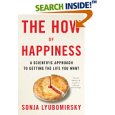
Eight ways gratitude boosts happiness

Sunday, November 23rd, 2008

Popular how-to book on happiness by leading researcherDoes cultivating gratitude increase happiness? Not very many studies have tackled this question directly, but the evidence so far from psychology research is pretty clear: Yes.

In her book The How of Happiness: A Scientific Approach to Getting the Life You Want, Sonja Lyubomirsky discusses eight ways gratitude boosts happiness.

1. Gratitude promotes savoring positive life experiences.

2. Gratitude may increase a sense of confidence and self-worth, by encouraging you to consider what you value about your current life.

3. Gratitude helps you cope with difficulties.

4. Gratitude encourages kindness and other moral behavior.

5. Gratitude helps strengthen relationships.

6. Gratitude inhibits envy.

7. Gratitude helps undermine negative emotions.

8. Gratitude keeps us from taking the good things for granted.

Here’s what she had to say in more detail, interspersed with my comments:

First, grateful thinking promotes the savoring of positive life experiences. By relishing and taking pleasure in some of the gifts of your life, you will be able to extract the maximum possible satisfaction and enjoyment from your current circumstances. When my first child was only a few months old, an older woman approached me while I was struggling with the stroller. “Your baby is so beautiful,: she said. “appreciate this age; it goes by so fast!” At the time I was feeling overwhelmed an sleep-deprived and, to be honest, didn’t much appreciate her glib intrusion, Click to continue »

Scientific analysis of morality

Thursday, November 13th, 2008

People have asked moral questions about the conduct of science, which has led to things like rules for how experiments should be conducted among other things. And psychologists have studied morality, beginning most notably with Lawrence Kohlberg who studied the structure of moral decision-making and came up with a hierarchical model with six stages of moral development based on reasoning about justice.

Recently psychologists who study happiness have come up with a few things related to morality that are interesting. I talked recently about the analysis of conservative and liberal morality undertaken by positive psychologist Jonathan Haidt. Another psychologist touched on the issue indirectly in a presentation at the TED (Technology, Entertainment, Design) conference in 2004. Dan Gilbert of Harvard University is an entertaining and informative speaker and author who recently published the bestseller Stumbling on Happiness, a delightful read in which he explains that we’re not always very good at predicting what is actually going to make us happy.


In the video of the TED conference presentation below, professor Gilbert talks about some aspects of what really makes people happy, including what he calls “synthetic happiness.” A lot of it is up to us. Being in a frame of mind where you are second-guessing an earlier decision is not conducive to happiness; sometimes it’s better for choices to be bounded. On the other hand, the environmental circumstances people find themselves in are not nearly as important as most people assume, because we’re quite good at adapting to both good and bad circumstances. Think about it: so many people make a lot of effort to make money, get a nicer house, car, clothes, furniture, electronic gadgets, etc. And some people strain so much in pursuit of such things that they’re willing to fudge something, to bend the rules – perhaps even enough to regret it later if they’re really honest with themselves. Dr. Gilbert quotes Adam Smith as having expressed a “turgid truth” in his description of pursuing such situations:

“Some of those situations may, no doubt, deserve to be preferred to others; but none of them can deserve to be pursued with that passionate ardour which drives us to violate the rules of either of prudence or of justice, or to corrupt the future tranquility of our minds, either by shame from the remembrance of our own folly, or by remorse from the horror of our own injustice.”

Having that thing you wanted so much is probably not going to make you nearly as happy in the long run as you thought anyway. So if in order to get it you need to cheat or otherwise do something that makes you feel not quite as good about yourself later, why do it? There may be other, even better reasons not to do it, but I thought the fact that Gilbert’s studies and conclusions had shed some light on this reason was interesting.

                  twitter.com/DrSteveWright