September, 2008

...now browsing by month


Sonja Lyubomirsky and the How of Happiness

Thursday, September 18th, 2008

“Dr. Happiness” Ed Diener and Professor Sonja Lyubomirsky are two of the leading researchers on happiness. A funny thing happened the day after I wrote my last post, where I introduced Dr. Diener and talked about his Life Satisfaction Scale. I got an email from Dr. Ben Dean (who I’ll talk about in a minute) saying Dr. Diener “is considered to be the world’s leading authority on research on happiness” and inviting me to a conference-call interview of Dr. Diener and Dr. Lyubomirsky that night.

Both Ed Diener and Sonja Lyubomirsky have written popular books about happiness. Sonja’s book has been out for awhile now. I just did a search for “happiness” in the “books” section of Amazon.com, and it came up second. It’s called: The How of Happiness: A Scientific Approach to Getting the Life You Want. It’s a how-to book. In the Foreword, she says “To my knowledge, this is the first how-to-become-happier book authored by someone who has actually conducted research revealing how people can achieve a greater sense of happiness in their lives.

She’s certainly qualified to talk about happiness: she was awarded a Templeton Positive Psychology Prize in 2002, she’s an associate editor of the Journal of Positive Psychology, and she and Ken Sheldon have a 5-year million-dollar grant from the National Institute of Mental Health to conduct research on the possibility of permanently increasing happiness.

Just looking at the table of contents gives you an idea how much she has to offer:

Part One: How to Attain Real and Lasting Happiness

1. Is It Possible to Become Happier?

2. How Happy Are You and Why?

3. How to Find Happiness Activities That Fit Your Interests, Your Values, and Your Needs

Part Two: Happiness Activities

Foreword to Part Two: Before You Begin

4. Practicing Gratitude and Positive Thinking

5. Investing in Social Connections

6. Managing Stress, Hardship, and Trauma

7. Living in the Present

8. Happiness Activity No.10: Committing to Your Goals

9. Taking Care of Your Body and Your Soul

Part Three: Secrets to Abiding Happiness

10. The Five Hows Behind Sustainable Happiness

The Promise of Abiding Happiness: An Afterword

Postscript: If You Are Depressed

Appendix: Additional Happiness Activities That May Fit

Dr. Lyubomirsky has found that happy people tend to perceive and interpret the world in ways that reinforce their happiness, and unhappy people do the reverse. Happy people respond in a more positive and adaptive way, while unhappy people tend to dwell or “ruminate” on negative or ambiguous events, draining cognitive resources and creating negative consequences.

She and her colleagues are investigating ways that happiness can be reliably and durably increased. They believe it can be done through intentional activities, but that these require “daily and concerted effort and commitment.” They are testing the effectiveness of gratitude exercises, “self-regulatory” and positive thinking about oneself (such as reflecting, writing, and talking about one’s happiest and unhappiest life events, or about one’s goals for the future), and practicing acts of kindness and altruism.
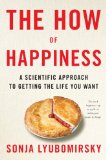
Popular how-to book on happiness by leading researcher

She talked about some of these things in the interview, and deals with how to apply some of them in practical ways in her book.

I want to talk about Ed Diener’s new book too, a bit more about the interview, and about Ben Dean’s work. But I think I’m going to have to break this up into several posts. In the meantime, take a look at Sonja’s book, The How of Happiness: A Scientific Approach to Getting the Life You Want.

Life Satisfaction – measure yours

Sunday, September 14th, 2008

Can “life satisfaction” be measured? How can a few questions be any kind of scientific measure of happiness, in the sense of my satisfaction with life?

Well, the “Satisfaction with Life Scale” below was developed by the man some call “Dr. Happiness,” who has studied this subject more than 25 years, who TIME magazine featured first among researchers in its January 17, 2005 special issue on happiness research. Dr. Ed Diener from the University of Illinois didn’t just make up five questions off the top of his head and call it a scientific instrument. There are a variety of ways to test such scales, and this one has been found to be valid (internally consistent, distinct) and reliable (stable) for both young and old.

Satisfaction with Life Scale

Try it yourself. Here are Dr. Diener’s instructions for taking the short survey questionnaire:

Below are five statements that you may agree or disagree with. Using the 1 – 7 scale below indicate your agreement with each item by placing the appropriate number on the line preceding that item. Please be open and honest in your responding.

7 – Strongly agree
6 – Agree
5 – Slightly agree
4 – Neither agree nor disgree
3 – Slightly disagree
2 – Disgree
1 – Strongly disgree

____ In most ways my life is close to my ideal.

____ The conditions of my life are excellent.

____ I am satisfied with my life.

____ So far I have gotten the important things I want in life.

____ If I could live my life over, I would change almost nothing.

Add the numbers you wrote beside each of the five questions to get a total. See below.

  • 31 – 35 Extremely satisfied
  • 26 – 30 Satisfied
  • 21 – 25 Slightly satisfied
  • 20 Neutral
  • 15 – 19 Slightly dissatisfied
  • 10 – 14 Dissatisfied
  • 5 – 9 Extremely dissatisfied

……….

We’ll be talking about the important issue of life satisfaction more in future posts. For now, make a list of things you are grateful for, if you haven’t already in conjunction with my “Gratitude leads to psychological and physical well-being” post. Think about your major activities and how they contribute to life satisfaction. For example, is there some improvement you could make to your work situation that would allow you to create more value? use your personal strengths more? help you get more involved in your work, get in the zone (find “flow”), and be more creative? or help you have a richer, fuller experience?

If on the other hand you are depressed or think you might be depressed, please pay it proper attention and get help. Among other benefits, overcoming depression is a key to life satisfaction; in a recent study, anxiety or anger had very little impact on life satisfaction compared to depression. Depression is a serious condition and should not be ignored.

References:

Pavot, W., & Diener, E. (1993). Review of the Satisfaction with Life Scale. Psychological Assessment, 5, 164-172.

Schimmack, U., Oishi, S., Furr, B M., & Funder, D. C. (2004). Personality and life satisfaction: A facet level analysis. Personality and Social Psychology Bulletin, 30, 1062-1075.

*The Satisfaction with Life Scale is in the public domain (not copyrighted) and so can be used without permission and free of charge.

Gratitude leads to psychological and physical well-being

Wednesday, September 10th, 2008

Gratitude is something that psychologists have started studying in a scientific way recently, thousands of years after its importance was recognized by philosophers, religious thinkers, and spiritual teachers. It turns out gratitude is strongly associated with quite a few aspects of psychological and physical well-being. According to research, grateful people have more positive emotion, life satisfaction, vitality, optimism, pleasant feelings, empathy, generosity, and less depression and stress. But how do psychology researchers know that’s not just because being a happy person causes gratitude? Or because having a good life causes both happiness and gratitude?

“Gratitude is not only the greatest of virtues, but the parent of all the others”

-Cicero

One way to find out is by doing an experiment. You get a group of people to do a “gratitude intervention” (keeping a gratitude journal or gratitude lists, or some other activity that encourages gratitude) and see how it affects other factors. Even better if you have another group as a comparison where everybody is doing some similar activity that doesn’t necessarily encourage gratitude.

Robert Emmons and Mike McCullough are two leading researchers on this topic. Here are some of their results:

In one experiment, the group of people who kept weekly gratitude journals had significantly better results on a range of psychological and physical well-being measures than the people in either of two comparison groups. The gratitude journal people exercised more regularly, reported fewer physical symptoms, felt better about their lives as a whole, and were more optimistic about the upcoming week than the other two groups (who recorded hassles in one group or neutral life events in the other).

Participants who kept gratitude lists were more likely to have made progress toward important personal goals (academic, interpersonal, and health-based) over a two-month period compared to participants in the other experimental groups.

In another study using daily self-guided exercises with young adults, the participants in the gratitude intervention group reported higher levels of the positive states of alertness, enthusiasm, determination, attentiveness and energy than the other two groups (who focused on hassles, or on how they thought they were better off than others). Also, the participants in the gratitude intervention group were more likely to report having helped someone with a personal problem or having offered emotional support to someone than those in the other two comparison groups.

In a third study, this time of adults with neuromuscular disease, a 21-day gratitude intervention resulted in better sleep duration and sleep quality, greater amounts of high energy positive moods, a greater sense of feeling connected to others, and more optimistic ratings of one’s life, relative to a comparison group.

The most robust effect across all three studies was the impact on people’s positive moods.

All the participants were randomly assigned to groups. So the gratitude interventions led to the improvements in psychological and physical well-being, not the other way around.

Martin Seligman, father of the modern “positive psychology” movement, recommends trying out the intervention, particularly for those who score in the lower half on the McCullough & Emmons “Gratitude Survey” or Ed Diener’s “Satisfaction with Life Scale.” In his best-selling book Authentic Happiness, Seligman describes it as follows:

Set aside five free minutes each night for the next two weeks, preferably right before brushing your teeth for bed. Prepare a pad with one page for each of the next fourteen days. The first night, take the Satisfaction with Life Scale (page 63) and the General Happiness Scale (page 46) once again and score them. Then think back over the previous twenty-four hours and write down, on separate lines, up to five things in your life you are grateful or thankful for. Common examples include “waking up this morning,” “the generosity of friends,” “God for giving me determination,” “wonderful parents,” “robust good health,” and “the Rolling Stones” (or some other artistic inspiration). Repeat the Life Satisfaction and General Happiness Scales on the final night, two weeks after you start, and compare your scores to the first night’s scores. If this worked for you, incorporate it into your nightly routine.

So here’s our special offer: Take our free two-week trial according to the description immediately above. If you don’t feel more alert, more enthusiastic, more determined, more attentive, more energetic, more optimistic, more happiness, and more satisfied with life; and if you’re not more helpful and supportive; we’ll give you double your money back!

References:

Emmons, R.A., & McCullough, M.E. (2003). Counting blessings versus burdens: Experimental studies of gratitude and subjective well-being in daily life. Journal of Personality and Social Psychology, 84, 377-389.

Seligman, M.E.P. (2002). Authentic Happiness: Using the New Positive Psychology to Realize Your Potential for Lasting Fulfillment. New York: Free Press. p. 75. Hardcover: ISBN 0-7432-2297-0; Paperback (2004): ISBN 0-7432-2298-9.


                  twitter.com/DrSteveWright